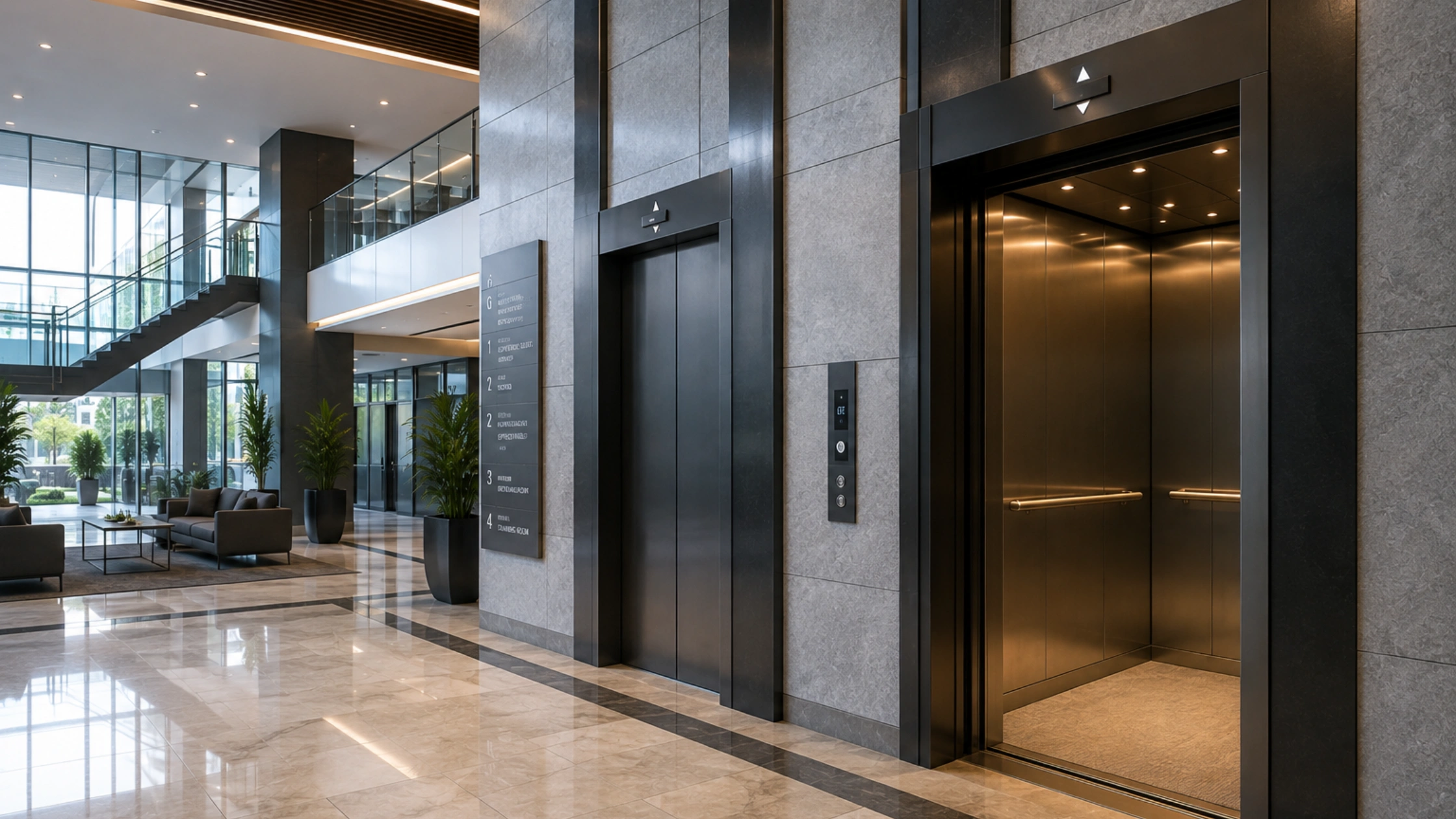
Anyone who has waited four minutes for a lift in an Outer Ring Road office block at 9:40 am knows what an undersized system feels like. The car arrives full, three people squeeze in, and the rest head back to the stairwell. Commercial Elevators Bangalore developers install are often sized on floor area alone, which is exactly how that queue forms. BG Elevators helps commercial property owners and developers evaluate lift capacity, speed, car count and traffic requirements before finalising the elevator system.
Traffic is the real design input. Get handling capacity right and everything else, from door width to finishes, falls into place. Get it wrong and no amount of clever dispatch software will fix a building that simply has too few cars.

Start With Traffic, Not With the Brochure
The number that matters is how many people the system moves in five minutes during the morning peak, expressed as a percentage of building population. Offices generally aim for 11 to 15 per cent, the higher end for single-tenant floors where everyone starts together.
Estimate population honestly. A dense IT floor plate in Whitefield can run at one person per 7 to 8 square metres of usable area, well beyond the one per 10 to 12 that older calculations assume. Underestimate it and you specify commercial elevators Bangalore tenants complain about within a month of occupancy. The second number is average waiting interval: under 30 seconds feels excellent, 30 to 40 seconds is acceptable, and past 50 seconds you will hear about it.
Commercial Elevators Bangalore: How Many Cars and What Capacity
Two smaller cars almost always outperform one large one. A single 20-passenger lift and a pair of 10-passenger lifts share the same nominal capacity, but the pair halves the waiting interval and keeps the building running when one is under service.
Commercial lift capacity by building type
| Building | Floors | Suggested cars | Capacity each | Speed |
|---|---|---|---|---|
| Small office / clinic | G+3 | 1 | 544 kg (8 person) | 1.0 m/s |
| Mid-size office | G+6 | 2 | 680 kg (10 person) | 1.0–1.5 m/s |
| Large office block | G+10 | 3–4 | 1020 kg (15 person) | 1.5–2.0 m/s |
| Retail / mixed use | G+5 | 2 + goods lift | 1020–1600 kg | 1.0–1.5 m/s |
Speed against travel height
Speed only pays off over distance. Below about six floors a faster machine spends most of its time accelerating and decelerating, so the gain is marginal. Above eight floors that flips, and 1.5 to 2.0 m/s starts to matter. Any commercial lift capacity decision should be paired with a speed suited to the travel, not picked off a price list.
Drive Types for an Office Building Elevator
Gearless traction with a variable-voltage variable-frequency drive is the default above four floors, giving smooth acceleration, levelling accurate to a few millimetres and lower running costs than older geared machines. Machine-room-less versions put the machine inside the shaft, freeing terrace space.
Geared traction still appears in goods lifts and low-rise duties where first cost dominates. Hydraulic systems suit two or three stops with heavy loads, a basement car park lift or a small showroom, but they draw more power on every upward trip. For a typical office building elevator in a G+6 block here, machine-room-less gearless is the sensible starting point among commercial elevators Bangalore suppliers stock.
Doors, Dispatch Logic and Ride Comfort
Door width decides how fast a car loads. An 800 mm opening is fine at home; a commercial car wants 900 mm to 1100 mm centre-opening so two people cross at once. Door operation is often the largest component of round-trip time, which is why cheap door gear destroys the traffic performance you paid for. It is the part of commercial elevators Bangalore buyers most often value-engineer and later regret.
Control logic matters just as much for commercial lifts Bangalore offices run at peak load:
- Simplex collective for a single car in a small building
- Duplex or group control for two to four cars, dispatching the nearest available unit
- Destination control for larger lobbies, where passengers enter their floor before boarding
- Peak modes parking cars at the ground lobby in the morning, reversed by evening
Destination control earns its premium above roughly eight floors with three or more cars; below that, good group control does the same job for less.
Fire Safety, Codes and Statutory Compliance
Commercial buildings carry obligations homes do not. Design and installation follow the IS 14665 series, while the National Building Code sets fire lift requirements, refuge floor arrangements and shaft pressurisation for taller buildings. In Karnataka, commercial elevators Bangalore owners operate must be registered under the state lifts legislation, with an operating licence and periodic inspection by the electrical inspectorate.
Confirm these before signing off any passenger elevator Bangalore project:
- Fire-rated landing doors with the correct resistance period for the shaft
- Fireman's switch and a designated fire lift where the building needs one
- Automatic Rescue Device with battery capacity for the full travel
- Emergency intercom to a manned point, not just an alarm bell
- Signed test certificates, load test records and the licence application
Power Supply, Backup and Running Cost
Commercial elevators Bangalore buildings run on a three-phase supply, with connected loads roughly 7.5 kW to 25 kW per car depending on capacity and speed. Regenerative drives push braking energy back into the building supply and can trim lift energy use meaningfully in a high-traffic block.
Backup is not a luxury here. Grid dips are routine, and a building without generator support for one car will strand people. Check the DG changeover time and whether the ARD covers every car or only the designated one.
Commercial Elevator Installation: Site Readiness and Timeline
A commercial elevator installation goes wrong for boring reasons. The shaft is out of plumb, the pit floods, the three-phase point was never pulled, or scaffolding came down too early. Hand over a shaft that is plumb, waterproofed, barricaded and lit, and the crew works to schedule.
Realistic timelines run six to fourteen weeks for manufacturing and delivery, three to six weeks of erection per car with overlap on multi-car banks, then testing, inspection and licensing. Treat statutory approval as weeks, not same-day paperwork.
Commercial Elevators Bangalore: Indicative Costs and AMC
Prices for commercial elevators Bangalore projects move with specification, so treat these as indicative. An eight-passenger machine-room-less unit for a G+3 building commonly starts around 18 to 28 lakh rupees supplied and installed. A 13 to 15 passenger gearless car at 1.5 m/s for a G+8 typically sits between 30 and 55 lakh. Destination control, stainless finishes, glass shafts and higher speeds all push upward.
Annual maintenance for commercial lifts Bangalore owners run generally falls between 40,000 and 1,20,000 rupees per car. Comprehensive contracts covering spares cost more but protect you from the one failure, usually a door operator or controller board, that wipes out a year of savings.
Frequently Asked Questions
1. How many lifts does a G+7 office building need?
Most G+7 offices with moderate floor plates need two to three passenger cars of 10 to 15 person capacity, plus a service or goods lift where there is retail or food service. The precise answer comes from a traffic study using actual floor areas and occupant density.
2. Do commercial elevators in Bangalore buildings need a machine room?
Not usually. Machine-room-less designs now cover most mid-rise commercial work and free up terrace area for other services. Machine rooms are still specified for very high speeds, heavy goods lifts, and buildings where owners prefer easier component access for long-term servicing.
3. What is the difference between a goods lift and a passenger lift?
Goods lifts have stronger floors, heavier door gear, plainer finishes and slower speeds, typically 0.25 to 0.5 m/s. A passenger elevator Bangalore offices use prioritises ride comfort, levelling accuracy and faster doors. Running daily freight in a passenger car wears out the door operator early.
4. How long does a commercial elevator installation take on site?
Erection usually runs three to six weeks per car once the shaft is handed over ready. Manufacturing and delivery come first, at six to fourteen weeks, and statutory inspection and licensing follow commissioning. Multi-car banks overlap, so a two-car job rarely takes twice as long as one.
Conclusion
Choosing Commercial Elevators Bangalore buildings will depend on for the next twenty years is a traffic exercise before it is a shopping exercise. Work out the population, peak demand and acceptable waiting interval, then let those numbers drive car count, capacity, speed and control logic. Protect the door equipment, controller, safety systems and backup arrangements in the budget because they have a greater effect on daily performance than decorative finishes.
If you are planning an office, retail, healthcare or mixed-use project, contact BG Elevators for a commercial lift consultation and get your building's capacity, traffic requirements, shaft planning and installation scope evaluated before finalising the specification. For more elevator insights, project updates and commercial lift planning tips, follow BG Elevators on Instagram and stay connected with the latest updates.