Builders often ask about elevator timelines too late in the construction process. When the structure is complete, plastering is underway, and possession dates are already promised, the lift requirement suddenly becomes urgent. BG Elevators helps project teams understand the stages involved, while BG Elevators can help builders plan their elevator requirements around the construction schedule. Typically, equipment manufacturing may take around eight to twenty weeks depending on the elevator type, specifications, customization, and component availability. A standard machine-room-less passenger lift and a heavy-duty goods lift with customized requirements will naturally have different timelines. Understanding the actual manufacturing stages helps builders coordinate civil work and avoid unnecessary delays.
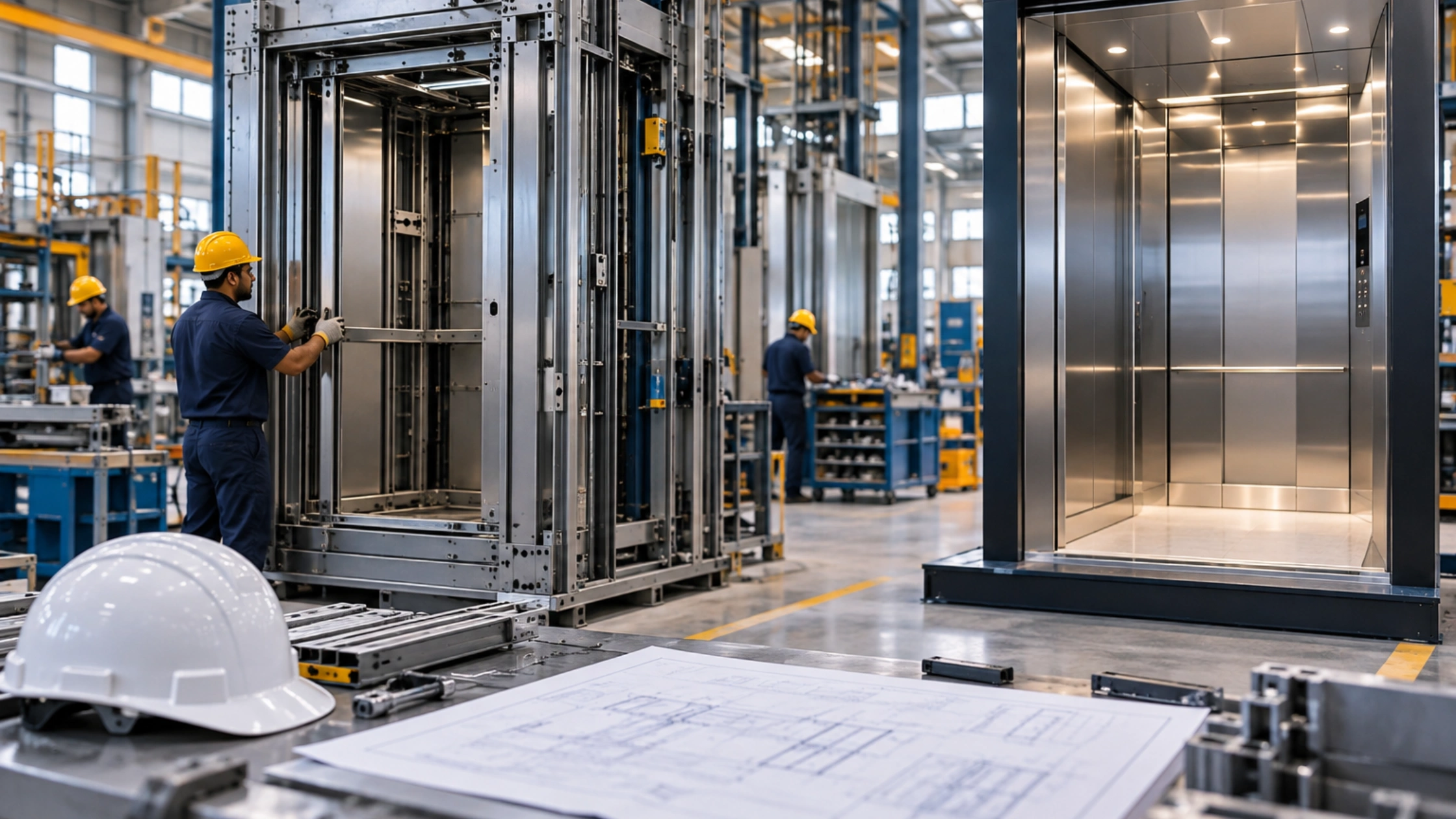
Alt text: Elevator manufacturing in a modern factory with workers assembling a lift.
What "Manufacturing Time" Really Covers
When a supplier quotes twelve weeks, ask what that clock includes. Some elevator manufacturing companies in Bangalore count from the day the advance is received. Others count from the day you approve the general arrangement drawing, which can be three weeks later if your architect is slow to respond.
Manufacturing typically covers car frame and platform fabrication, cabin panels, door assemblies, the controller build and wiring, and either sourcing or assembling the traction machine. Guide rails, ropes, buffers and safety gear are usually bought-in items with their own lead times. The tricky part is that a single late component holds up dispatch of the whole set, because nobody ships half a lift.
The Elevator Manufacturing Process, Stage by Stage
The elevator manufacturing process is more sequential than most buyers expect. Fabrication can't start until drawings are frozen, and drawings can't be frozen until the shaft dimensions are confirmed on site.
Design freeze and approval drawings
Two to three weeks for a standard model, longer for anything custom. The output is a general arrangement drawing showing car size, shaft clearances, pit depth, headroom, door opening and machine position. Every day your team sits on that drawing is a day added to the schedule. Builders who route approvals through three consultants routinely lose a fortnight here.
Fabrication and sourcing
Four to ten weeks, and this is where most lift manufacturing effort sits. Sheet metal work on the cabin and doors runs in parallel with the controller build. Gearless machines, VVVF drives and specialised door operators are frequently imported or sourced from another state, and those items set the critical path. Stainless steel cabin finishes, glass panels and non-standard door widths all add time because they leave the standard production run.
Realistic Lift Production Time from Elevator Manufacturing Companies in Bangalore
Indicative ranges from drawing approval to material dispatch:
|
Lift type |
Typical capacity |
Lift production time |
Notes |
|
Home lift, standard cabin |
204–272 kg, 3–4 persons |
6–9 weeks |
Shortest if the model is a catalogue standard |
|
Passenger lift, MRL |
408–680 kg, 6–10 persons |
8–12 weeks |
Most common apartment specification |
|
Passenger lift, custom cabin |
544–1020 kg |
12–16 weeks |
Glass, stainless or designer finishes |
|
Hospital or stretcher lift |
1020–1600 kg |
12–18 weeks |
Wide doors, deeper car, longer fabrication |
|
Goods lift |
1000–3000 kg |
12–20 weeks |
Heavy structure and custom openings |
|
Hydraulic lift |
Varies |
10–16 weeks |
Power pack and cylinder lead time dominates |
Treat these as planning figures, not commitments. Order-book load matters as much as the specification, and the pre-monsoon months bring a rush of builders trying to finish before the rains.
What Elevator Manufacturing Companies in Bangalore Need From You First
Nothing slows a build like incomplete information. Before fabrication starts, expect to supply confirmed shaft dimensions measured on site rather than taken from the sanctioned plan, the number of stops and floor-to-floor heights, capacity in kilograms and persons, door type and opening width, the power supply arrangement including whether a DG backup exists, and your cabin finish selection.
That last one causes more delay than anything else. Buyers change cabin material after fabrication has begun, and the change order resets part of the schedule. Decide the finish before you sign, not after.
What Actually Stretches an Elevator Project Timeline
Site readiness
The lift arrives and can't go in. Shaft not plastered, pit not waterproofed, no three-phase supply at the machine location, scaffolding still occupying the hoistway. Material then sits in storage, sometimes for weeks, and reinstalling a crew costs you both money and priority in the installation queue.
Mid-project changes
A capacity increase from 408 kg to 544 kg sounds minor. It changes the car frame, the machine, the ropes and often the shaft clearances, and it can push an elevator project timeline out by six weeks. Approvals for the changed drawing start again from scratch.
Traffic and access matter too. Elevator manufacturing companies in Bangalore know that getting a consignment into a narrow site off a congested arterial road usually means a night delivery slot, and that has to be booked in advance rather than assumed.
Installation, Testing and Elevator Delivery to Site
Elevator delivery is not the finish line. Once material reaches site, installation for a standard mid-rise passenger lift runs roughly three to five weeks: rail alignment, machine and controller mounting, car assembly, door installation at every landing, wiring, then commissioning.
Testing follows. Load tests, overspeed governor and safety gear checks, door timing, levelling accuracy and ARD operation all get verified before anyone rides it. Under the Karnataka lift rules, the installation must be inspected and licensed before it goes into legal use, and that paperwork takes its own time. Budget two to four weeks between mechanical completion and lawful handover, and don't promise buyers a date that assumes zero queue at the inspectorate.
Compressing the Schedule Without Cutting Corners
- Order the lift at foundation stage, not at finishing stage. This single decision saves more time than everything else combined.
- Freeze the general arrangement drawing within a week of receiving it.
- Choose a catalogue cabin and standard door width unless there's a real design reason not to.
- Get the shaft measured by the supplier's engineer, not just by your site team.
- Have three-phase power and a dry, plastered shaft ready before dispatch.
- Ask for the inspection application to be filed as soon as commissioning is scheduled.
Frequently Asked Questions
1. How early should I place a lift order?
As soon as the structural drawings are final and the shaft dimensions are fixed, which for most projects means around the time the foundation is being cast. Ordering at the foundation stage means the equipment is ready roughly when the shaft is. Ordering at the plastering stage almost always means waiting.
2. Can a lift be manufactured faster than the quoted time?
Sometimes. Elevator manufacturing companies in Bangalore can compress a build if the model is a standard catalogue unit and the machine and controller are in stock. Expedited work usually carries a premium and depends on order-book load. Custom cabins, non-standard capacities and imported drives cannot realistically be rushed.
3. Does a home lift take less time than an apartment lift?
Usually yes. Compact home lifts are built to a smaller set of standard configurations, so lift manufacturing runs shorter, often six to nine weeks. Installation is also quicker because travel is short and there are fewer landings. Custom glass cabins erase most of that advantage.
4. What happens if my site isn't ready when the lift is?
Most suppliers will store the material, sometimes free for a short grace period and then at a charge. The bigger cost is losing your slot in the installation schedule. Coordinate the dispatch date with your civil progress rather than accepting whatever date the factory offers.
Conclusion
For most building projects, planning around three to five months from order to legally usable elevator is a sensible approach, although actual timelines vary by elevator type and project requirements. Equipment production is only one part of the schedule; drawing approvals, component sourcing, lift manufacturing, site readiness, installation, testing, and statutory inspection can all affect the final handover date. BG Elevators can help project teams understand these stages early, while BG Elevators can assist with planning an elevator solution according to the building's requirements.
Need a project-specific elevator timeline and quotation? Contact BG Elevators today and plan your lift installation with greater confidence.
Follow us on Instagram for elevator designs, projects, solutions, and industry updates.