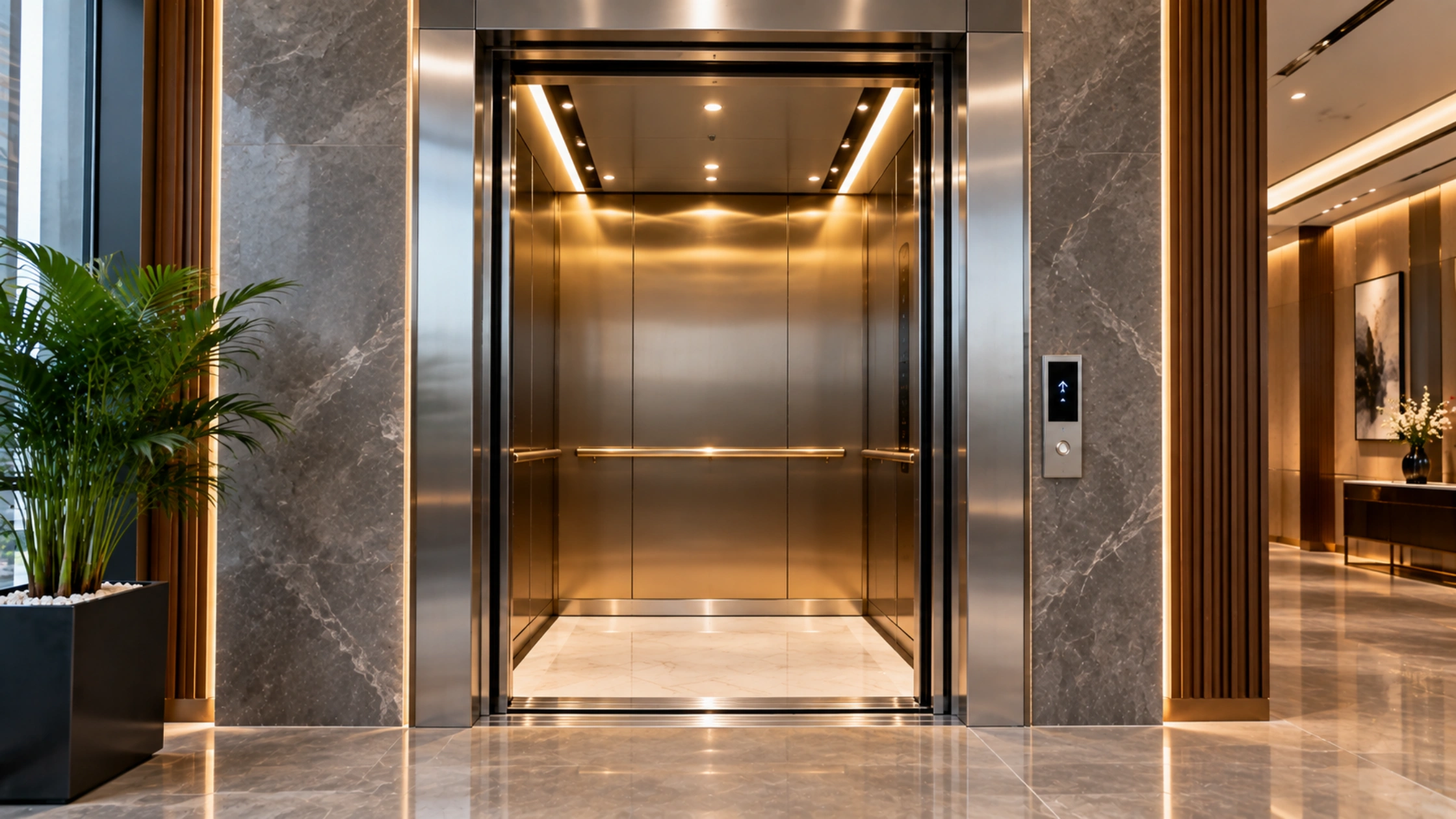
Choosing the right elevator should begin before the lift shaft is constructed. BG Elevators helps builders evaluate important specifications early, while BG Elevators can help project teams consider shaft dimensions, capacity, cabin size, speed, doors, safety systems, and long-term maintenance requirements. A quotation may look attractive because it shows the same capacity and similar cabin images, but important differences can exist in drive technology, overhead clearance, door configuration, controller systems, and service support. Comparing these details during the design stage can prevent expensive structural changes and help builders select an elevator that suits the building.
Alt text: Passenger lift with builders reviewing plans.

Start With the Shaft, Not the Brochure
Every elevator decision is closely connected to the building structure. Once the hoistway is constructed, changing the dimensions can become expensive and time-consuming.
Before comparing suppliers, confirm:
- Clear internal shaft width and depth
- Pit depth
- Available overhead clearance
A typical six- to eight-passenger machine-room-less unit may require approximately 1,600–1,900 mm of shaft width, around 1,100–1,500 mm of pit depth, and approximately 3,600–4,200 mm of overhead clearance. Actual requirements depend on the selected elevator system.
Builders should share architectural drawings with two or three Passenger Lift Manufacturers in Bangalore during the design stage and ask them to confirm the required shaft dimensions.
Different manufacturers may recommend different dimensions for the same rated load because of variations in car frame, rail, door, and equipment design.
Passenger Elevator Capacity: Sizing for the Building, Not the Budget
Rated load versus what the cabin really holds
Passenger elevator capacity is quoted in kilograms and in persons, and the person figure flatters. A 408 kg lift is sold as six persons on a 68 kg average. In a block where people carry grocery bags, a pram or a gas cylinder, six is a paper number. Treat 544 kg as the practical floor, and 680 kg where the lift also handles furniture moves.
Traffic patterns decide how many lifts, not just how big
Two smaller lifts usually beat one large one. Waiting times drop, and a breakdown doesn't strand the building. Count flats per floor, total floors and the morning peak. A G+4 with two flats per floor is comfortable on one eight-passenger unit. A G+12 with four flats per floor and a single lift generates complaints fast.
Lift Cabin Size, Shaft Width and the Numbers That Clash
Lift cabin size is where marketing and mathematics fall out. The internal cabin is always smaller than the shaft by the car frame, guide rails, door operator and running clearance, so ask for internal clear dimensions in millimetres rather than platform size. Three checks before you sign off a drawing:
- Stretcher clearance. In a G+4 or taller, one lift should take a stretcher diagonally. Roughly 1,100 x 2,000 mm handles it; a square cabin does not.
- Clear door opening. 800 mm feels tight with luggage. 900 mm is the residential default.
- Furniture diagonal. Check a three-seater sofa and a double mattress against the cabin diagonal before approving the lift cabin size.
Elevator Speed, Drive Type and What Each Combination Costs
Elevator speed is quoted in metres per second, and Bangalore's mid-rise stock rarely needs anything dramatic. Up to G+6, 0.5 to 0.7 m/s is civilised. From G+7 to about G+15, 1.0 m/s is the sensible band. Buying more elevator speed than your travel height justifies mostly buys a bigger electricity bill.
Comparing the three common drives
- Machine-room-less gearless traction: the all-round choice for residential and small commercial buildings. No machine room, good energy figures, smooth ride, needs adequate overhead.
- Hydraulic: low overhead demand and forgiving on structure, which suits retrofits and low-rise villas. Higher running cost, and speed usually capped near 0.3 to 0.5 m/s.
- Geared traction with a machine room: durable and simple to service, but you surrender terrace space.
Passenger Lift Specifications Worth Writing Into the Contract
Verbal assurances evaporate. These passenger lift specifications belong in the purchase order as numbers, not adjectives.
|
Specification |
What to ask for |
Why it matters |
|
Rated load |
kg first, persons second |
Person counts flatter small cabins |
|
Internal cabin |
Clear width x depth x height, mm |
Decides furniture and stretcher fit |
|
Doors |
Type plus clear opening in mm |
Manual doors age badly in shared buildings |
|
Drive and controller |
Gearless MRL or hydraulic, VVVF |
Sets ride quality and running cost |
|
Power supply |
kVA demand and starting current |
Undersized DG sets stall on start |
|
ARD |
Included, with backup duration |
Local outages make this near-essential |
Most passenger lift manufacturers in Bangalore price a standard six to eight passenger machine-room-less lift for a G+4 residential building somewhere between Rs 12 and 20 lakh installed, rising with travel height, finish and door specification. Any figure stays indicative until a site survey.
Doors, Safety and Passenger Lift Features That Get Used Daily
Some passenger lift features read like extras on paper and turn out to be the ones residents notice. An automatic rescue device brings the car to the nearest landing during a power cut and opens the doors, which matters in a city where evening outages are routine. Infrared door curtains are meaningfully safer than a mechanical safety edge. Insist too on overload detection, cabin emergency lighting, an intercom to a manned point, and a firefighters' switch where height requires it. Then ask any shortlisted supplier what happens when nobody answers that intercom at 11 pm.
What Passenger Lift Manufacturers in Bangalore Must Support on Compliance
Karnataka regulates lifts through its own Lifts, Escalators and Passenger Conveyors legislation: permission to erect, a licence to operate, then periodic inspection. Design and safety practice sits on IS 14665. Ask each supplier who prepares the applications, who attends the inspection, and whether that work is priced in or billed later.
Serious passenger lift manufacturers in Bangalore hand over a compliance checklist without being pushed. If a vendor is vague about licensing, treat that as a preview of how they'll behave in a warranty dispute. Confirm electrical inspectorate requirements early too, since power sanction timing often decides handover.
Comparing Passenger Lift Manufacturers in Bangalore Beyond the Price Line
Two quotes two lakh apart can differ by far more over ten years. Ask how many service engineers sit within 25 km, what the contracted response time is for a trapped-passenger call, and whether the controller is proprietary. Proprietary controllers aren't automatically bad, but your maintenance options narrow once the warranty ends.
Ask for reference sites of similar height and age, then visit one unannounced. Ride the lift. Listen at the landing. A five-year-old installation tells you more about passenger lift manufacturers in Bangalore than any brochure comparison of passenger lift specifications.
Frequently Asked Questions
How much does a passenger lift cost in Bangalore?
For a standard six to eight person machine-room-less residential lift in a G+4 building, indicative installed costs commonly sit between Rs 12 and 20 lakh. Cabin finish, travel height, door type and speed all move that number. Annual maintenance is quoted separately, per lift per year, once the warranty ends.
What passenger elevator capacity suits a small apartment block?
For most G+3 to G+5 buildings with two or three flats per floor, 544 kg or eight persons is the practical choice. It absorbs daily traffic and shifting-day loads, and takes a stretcher if the cabin is rectangular. Going smaller saves little and generates complaints quickly.
Do I need a licence to run a lift in Karnataka?
Yes. State legislation requires permission before erection and a licence before the lift carries passengers, followed by periodic inspection and renewal. Most established passenger lift manufacturers in Bangalore handle this paperwork as part of the project, but confirm in writing whether fees and follow-up visits are inside your quoted price.
How long does installation take once the shaft is ready?
With a completed shaft, correct pit and overhead, three-phase power available and scaffolding cleared, a typical low-rise passenger lift takes roughly three to six weeks from material delivery to testing. Delays almost always come from civil readiness, power sanction or monsoon site access rather than the elevator work itself.
Conclusion
Selecting a passenger elevator is a long-term building decision, so specifications should be finalized before construction reaches the point where structural changes become difficult. Builders should confirm shaft, pit, and overhead dimensions during design, specify capacity and cabin measurements clearly, and evaluate suppliers based on installation expertise and long-term service support rather than price alone. BG Elevators can help builders assess the right specifications for their project, while BG Elevators provides elevator solutions for different residential and commercial requirements.
Planning a passenger lift for your upcoming building project? Contact BG Elevators today for a professional consultation, site assessment, and customized elevator quotation.
Follow us on Instagram for elevator designs, project updates, elevator solutions, and industry insights.