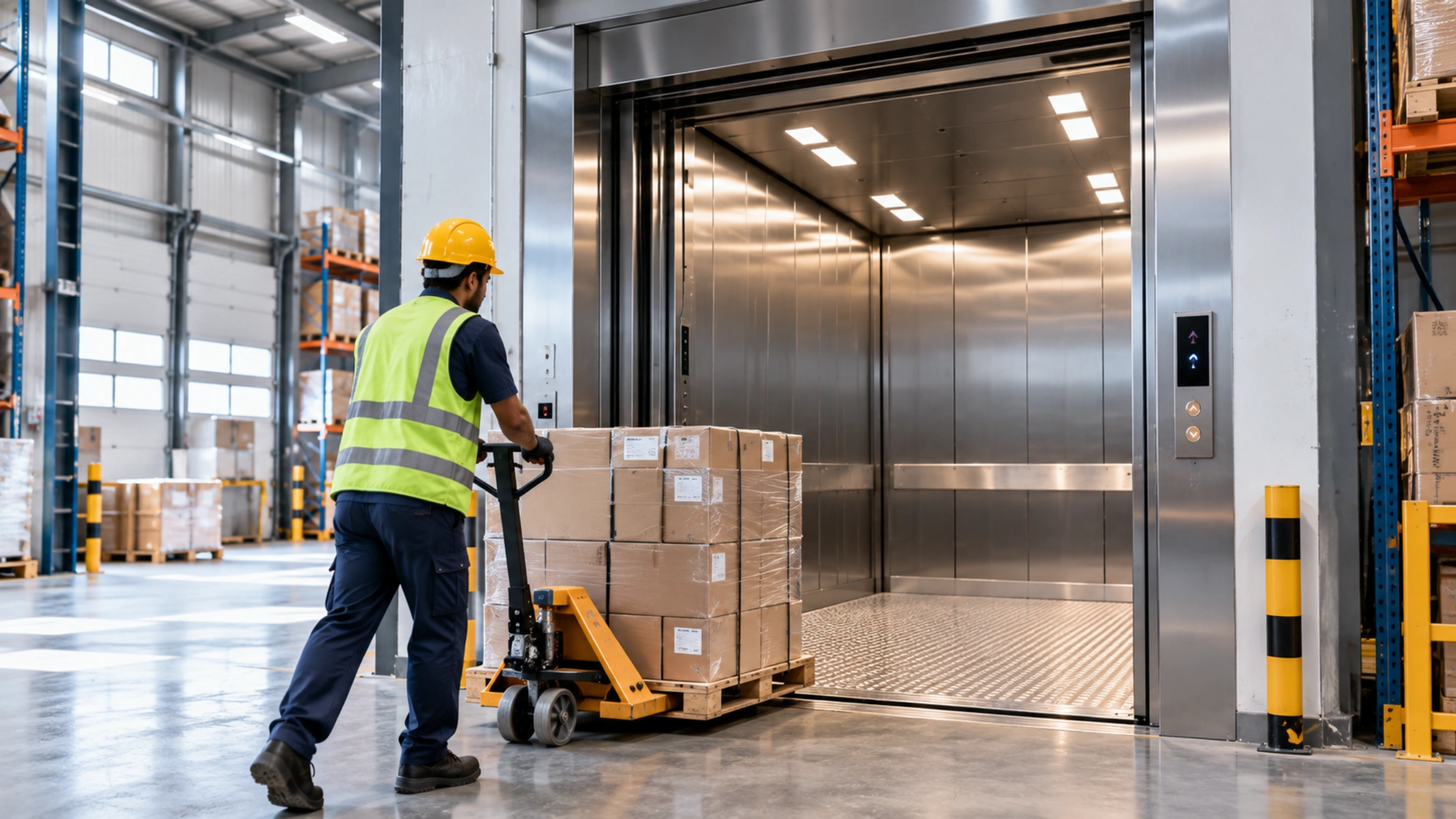
A detailed specification is the starting point for getting the right goods for your business. BG Elevators helps businesses understand important requirements before selecting equipment, while BG Elevators can assess factors such as load, dimensions, travel height, access, power supply, and operating frequency. Simply asking for a "1-ton goods lift" may not be enough because the actual load can include pallets, trolleys, stackers, and operators. Sharing accurate information at the beginning helps a manufacturer design the lift correctly, prepare a realistic quotation, and reduce changes later in the project.
Alt text: Worker inspecting a goods lift loaded with pallets and boxes.

Why a Vague Enquiry Costs You Twice
Send "need a goods lift for a 3-floor building" and you'll get a price for a generic unit. That number changes once the real requirements surface, usually after you've budgeted around it. You also can't compare two quotes built on different assumptions.
Detailed industrial lift specifications get taken seriously. A goods lift manufacturer in Bangalore who receives dimensions, loads and a description of the goods will size the structure properly, flag civil work you hadn't considered, and give a date you can plan around.
Load: The Number Everything Else Follows From
Start with the heaviest single load you will ever put in the car, then add the handling equipment and the operator. Say you move 800 kg of packaged goods on a pallet truck. The truck weighs 70 to 120 kg, the pallet 25 kg, the operator perhaps 75 kg. You're at roughly 1000 kg minimum, and you should specify above that.
Overloading is the most common failure pattern in industrial installations. It wears ropes, shortens brake life and trips safety gear. Under-specifying to save money in year one costs more in year three.
Goods lift requirements beyond the headline load
Tell the supplier what the goods physically are. Steel coils concentrate weight on a small footprint and need a stronger platform than the same mass spread across cartons. Liquids in drums shift during travel. Long items may need to load diagonally. Anything hot, wet, corrosive or dusty changes the material choice for the platform and the finish. These goods lift requirements shape the design far more than the kilogram figure alone.
Goods Elevator Capacity and Duty Cycle
How often it runs
Goods elevator capacity is only half the picture. A lift making 15 trips a day and one making 150 are different machines at identical load. Tell the supplier trips per hour at peak, whether operation runs continuously through a shift, and whether loading is by forklift entering the car or by trolley.
Forklift entry matters. A forklift driving into the car imposes point loads far above the rated static load, and the platform must be built for it.
Persons on board
Clarify whether people will ride with the goods. Goods lifts and passenger-cum-goods lifts are treated differently for safety fittings and licensing. If an operator travels with the load, declare it at design stage rather than retrofitting later.
Dimensions Your Goods Lift Manufacturer in Bangalore Needs
Give internal shaft dimensions measured on site, floor-to-floor heights, total travel, pit depth available and clear headroom. State which sides need openings, because a car with two entrances at 90 degrees changes the whole layout.
|
Specification |
What to state |
Typical range |
|
Rated load |
Heaviest load plus handling equipment |
500–5000 kg |
|
Platform size |
Length x width, driven by pallet or trolley size |
1200 x 1200 to 2500 x 3000 mm |
|
Clear door opening |
Width and height, allow for stacker mast |
1200–2500 mm wide |
|
Travel |
Ground to top served level |
3–25 m typical |
|
Pit depth |
Measured, not assumed |
300–1600 mm |
|
Headroom |
Clear height above top landing |
3000–4500 mm |
|
Speed |
Slower is fine for goods |
0.15–0.5 m/s |
|
Stops and openings |
Number of stops, sides of entry |
Varies |
Treat those ranges as indicative. A goods lift manufacturer in Bangalore will confirm the exact figures against the equipment being offered and the site survey.
Doors, Gates and Loading Access
Door choice affects cost and daily workflow. Manual imperforate doors are cheap and durable but slow. Vertical bi-parting doors suit wide openings and take no floor space. Power-operated centre-opening doors cost more and earn it where handling volume is high, which is a detail worth settling early in the goods lift design.
The mistake to avoid is a door opening narrower than your loading equipment. Measure the widest thing that must pass through, including the mast height of a lowered stacker, and specify 100 mm of margin. Mention floor level tolerance too, since a 10 mm step makes trolley loading awkward and slows every trip.
Drive Type, Power and Site Conditions
Hydraulic against traction
For low-rise industrial buildings up to about four levels, hydraulic drives suit heavy loads, need no machine room above the shaft, and handle high point loads well. Traction systems make more sense for taller travel and frequent use because they consume less energy per trip and run faster. Your goods lift design should follow the building, not the other way round.
Power and environment
State the supply available: three-phase or single-phase, sanctioned load, whether a DG backup exists, and typical voltage stability. Describe the environment honestly. A lift in a cold storage unit, a chemical plant or an open-sided godown near dusty industrial roads needs different protection ratings and finishes from one in a clean assembly building. Good industrial lift specifications always cover environment; skip it and you'll see rusted platforms within two years.
Safety Details Your Goods Lift Manufacturer in Bangalore Must Confirm
Any freight lift installed in Karnataka falls under the state's lift rules and must be inspected and licensed before use. Confirm early who applies for the licence. Ask which parts of IS 14665 the equipment complies with, and get the safety fittings listed explicitly: overload sensing, safety gear, overspeed governor, terminal limit switches, emergency stop, interlocks on every landing door, and a phase-failure device.
For a freight lift in a production environment, also agree what happens during a power cut. An automatic rescue device or manual lowering arrangement should be specified rather than assumed.
The Checklist to Send With Your Enquiry
- Rated load in kg, including handling equipment and operator.
- What the goods physically are, and how they're loaded.
- Platform length and width required.
- Number of stops, travel height, floor-to-floor dimensions.
- Shaft internal dimensions, pit depth, headroom, all measured.
- Door type, clear opening width and height, sides of entry.
- Trips per hour at peak and hours of operation.
- Power supply details and DG availability.
- Environmental conditions: dust, moisture, temperature, chemicals.
- Whether personnel will travel with the load.
Send that to a goods lift manufacturer in Bangalore and you'll get a realistic quotation, not a placeholder.
Frequently Asked Questions
How much does a goods lift cost?
Prices vary widely with capacity, travel, door type and structure, so treat any figure quoted without a site survey as indicative only. A compact 500 kg unit serving two levels sits at one end of the scale and a 3000 kg forklift-rated lift at the other. Ask for a written breakdown covering equipment, installation and civil work separately.
Can a goods lift be installed in an existing building?
Usually yes, though it depends on headroom, floor cutting and structural capacity. Where no shaft exists, a self-supporting steel shaft can be erected inside or against the building. A site survey by your goods lift manufacturer in Bangalore is essential before you commit, because slab strength and column positions decide feasibility.
Do goods lifts need a licence in Karnataka?
Yes. Lifts installed in the state must be registered, inspected and licensed before being put into use, and the licence needs periodic renewal. Your supplier normally handles the application, but confirm that in writing. Operating an unlicensed lift creates both legal exposure and insurance problems.
What capacity should I choose if my loads may grow?
Specify for realistic future load rather than today's maximum, because upgrading capacity later means changing the machine, ropes and often the structure. Moving from 1000 kg to 1500 kg at the order stage adds a modest amount to the price. Doing it three years later can cost close to a new installation.
Conclusion
The quality of the specification directly influences the quality and suitability of the goods lift you receive. Load, platform dimensions, duty cycle, door openings, power supply, operating environment, and handling methods should all be clearly communicated before production begins. Accurate site measurements and a professional survey can also prevent costly changes later. BG Elevators can help businesses evaluate these requirements, while BG Elevators provides elevator solutions designed around different commercial and industrial applications.
Planning a new goods lift for your warehouse, factory, or commercial property? Contact BG Elevators today to share your requirements and get a project-specific recommendation and quotation.
Follow us on Instagram for elevator solutions, project updates, product designs, and industry insights.