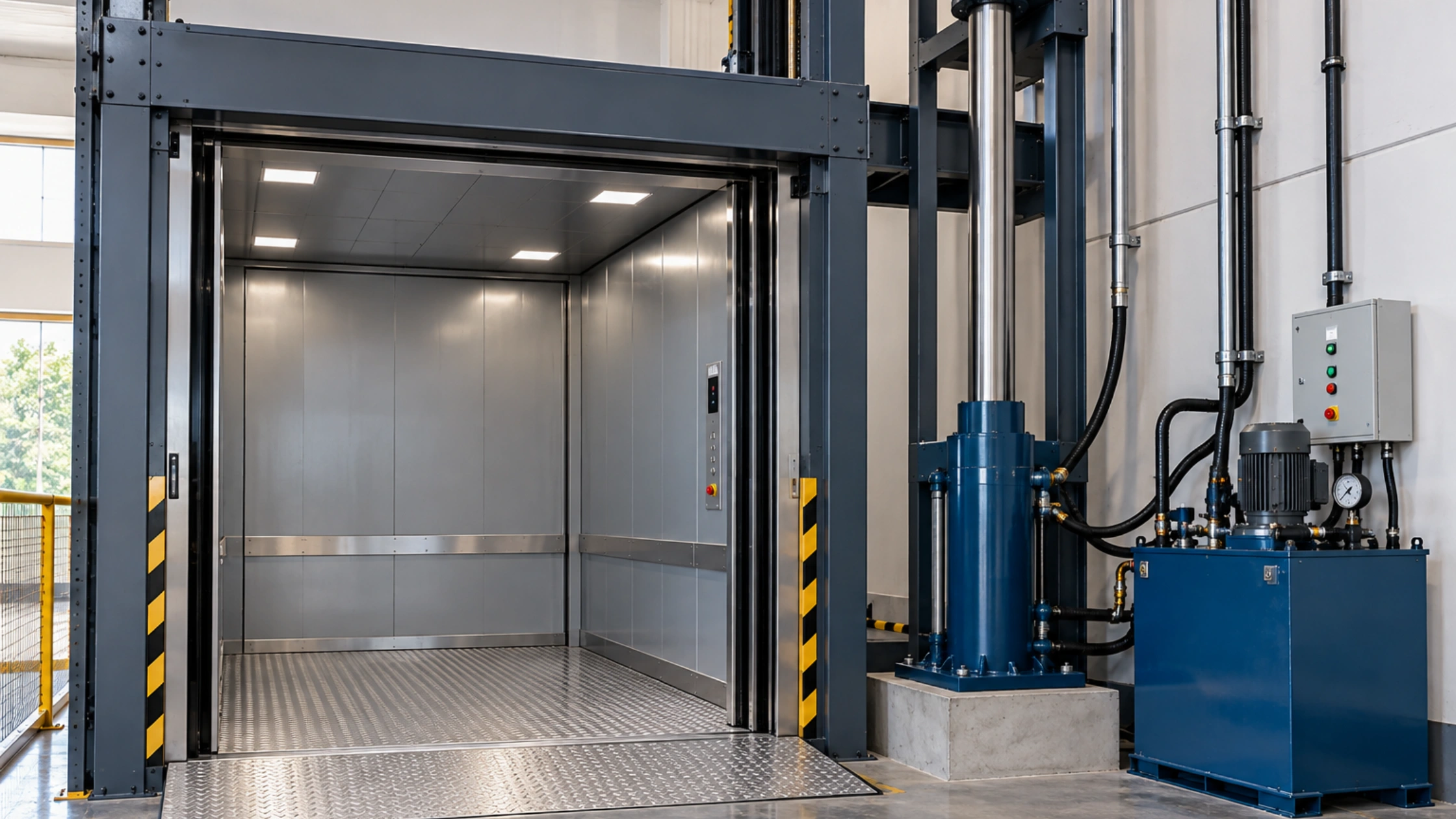
A hydraulic goods lift can be a practical solution for businesses that need to move heavy materials across a few floors, especially when building space is limited. BG Elevators helps businesses evaluate factors such as load, travel height, building structure, and operating frequency, while BG Elevators can recommend suitable elevator solutions based on the site and application. Hydraulic systems are particularly useful for low-rise buildings handling substantial loads, where a conventional traction system may not be the most practical choice. However, the technology is not ideal for every application, so understanding its advantages and limitations is important before making a decision.
Alt text: Hydraulic goods lift carrying pallets in a warehouse.

What a Hydraulic Goods Lift Actually Is
Instead of ropes over a sheave driven by a motor above the shaft, a hydraulic system pushes the car up on a cylinder using oil pumped from a tank. Descent uses gravity, with a valve controlling flow back into the tank. There's no counterweight and no machine room overhead, which is why the design suits buildings where the roof can't take equipment.
Two arrangements dominate. Direct-acting units place the ram under the car and are simplest, though they need a borehole below the pit for longer travel. Side-acting designs use a ram alongside the car with a rope or chain multiplier, doubling travel for a given cylinder length. Your supplier picks between them on pit depth, travel and load.
Where Hydraulic Lift Applications Make Sense
The typical hydraulic lift applications share a profile: two to four levels, substantial loads, and a building that was never designed with a lift shaft in it. Workshops, godowns, cold stores, small manufacturing units, restaurants moving stock between kitchen and store, and retail buildings with a basement all fall into this bracket.
A hydraulic goods lift also handles point loading well. If a forklift drives into the car, the platform carries loads far beyond the rated static figure, and hydraulic systems tolerate that better than a rope-driven car of similar cost. Loading docks, where trolleys and stackers roll in and out all day, sit comfortably here too.
The other common case is retrofitting. Because the shaft doesn't carry machine weight at the top and there's no counterweight running alongside, a self-supporting steel structure can be erected in a corner of a shed or against an outside wall. Most hydraulic goods lift Bangalore enquiries start exactly there, with an existing building and no shaft.
Hydraulic Lift Capacity and Travel Limits
Hydraulic lift capacity is where this technology genuinely outperforms. Heavy loads at low speed are exactly what a cylinder does well.
|
Parameter |
Typical hydraulic range |
Comment |
|
Rated load |
500–5000 kg |
Higher available for special builds |
|
Travel |
Up to about 15–18 m |
Practical limit, longer is inefficient |
|
Stops |
2–5 |
Beyond this, traction usually wins |
|
Speed |
0.15–0.3 m/s |
Slow by design, fine for goods |
|
Pit depth |
300–1200 mm |
Shallower options exist |
|
Headroom |
Roughly 3000–3600 mm |
Lower than traction equivalents |
Treat these as indicative planning figures. Actual values depend on the equipment offered, platform size and structure, and a site survey will refine them.
Speed is the trade-off you accept. A traction goods elevator runs three or four times faster. For two floors and a trolley, that barely registers. For six floors and a busy warehouse, it becomes the whole argument.
Hydraulic Against Traction: An Honest Comparison
Choosing between a hydraulic goods lift and a traction machine comes down to six practical differences.
- Building impact: hydraulic needs no machine room above the shaft and imposes lower loads on the roof structure; traction needs overhead support or an MRL arrangement with adequate headroom.
- Capital cost: at low travel and heavy load, hydraulic is usually cheaper; the gap closes and reverses as travel increases.
- Energy use: traction consumes less per trip because the counterweight balances the car; hydraulic draws power only going up, but that stroke is power-hungry.
- Speed and duty: traction suits high traffic and taller buildings; hydraulic suits low travel with moderate trip frequency.
- Maintenance: hydraulic has fewer moving parts overhead but needs oil monitoring, seal checks and attention to temperature.
- Failure behaviour: loss of power allows controlled manual lowering to the nearest landing, a real advantage where supply is unreliable.
Running Costs, Oil and Maintenance
What actually needs attention
Seals, hoses, valve blocks and oil condition. The pump runs only on the up stroke, so motor hours are lower than you'd expect, but the oil takes heat every time it runs. In a shed with a tin roof in April, oil temperature climbs, viscosity drops and levelling accuracy suffers. A cooler or a ventilated power pack room fixes it, and planning for it costs far less than retrofitting it.
Expect an annual oil check, periodic filter changes and seal inspection. Any industrial hydraulic lift working two shifts belongs on a maintenance contract rather than a call-out arrangement, because a seal weeping unnoticed becomes an oil spill on a production floor.
Energy in practice
Because descent uses gravity, roughly half your trips draw no motor power at all. That partly offsets the higher current on the up stroke. In a building doing 40 to 60 trips a day with heavy loads over two floors, the total energy difference against a traction alternative is usually modest. Over ten floors it isn't modest at all.
Site Requirements for a Hydraulic Goods Lift
Space and civil work
You'll need a power pack room or cupboard, typically around 1000 x 1500 mm, close to the shaft, because long oil lines add cost and lag. The pit must be dry, and that matters more than people expect in Bangalore, where a poorly drained pit in a ground-floor godown fills during heavy pre-monsoon showers and corrodes the cylinder base.
Direct-acting units with travel beyond a couple of levels may need a borehole below the pit for the ram. That's a drilling job with its own cost and access requirements, so raise it early rather than discovering it after the order.
Power and environment
Three-phase supply is standard for any industrial hydraulic lift above modest capacity. Voltage stability matters, and if the unit runs on a DG set during outages, say so, because starting current has to be accounted for. Dusty or corrosive environments need protection on the power pack and suitable platform finishes.
When Something Else Is the Better Answer
Don't force technology. Above four or five stops, or where travel exceeds roughly 15 metres, a traction goods elevator becomes cheaper to run and considerably faster. High-frequency operation, a lift cycling continuously through an eight-hour shift, also favours traction because oil heating limits duty cycle.
If people ride with the goods regularly and the building is tall, a passenger-rated traction system is the right specification. Where energy cost is scrutinised closely, the counterweight advantage compounds over years.
Frequently Asked Questions
How many floors can a hydraulic goods lift serve?
Practically, two to five stops with total travel up to roughly 15 to 18 metres. It's technically possible to go further, but cylinder length, oil volume and energy consumption all rise steeply, and the speed penalty becomes hard to justify. Beyond that range, a traction system is normally the better engineering and commercial choice.
Is a hydraulic goods lift safe during a power cut?
Yes, and it has a useful advantage. Because descent relies on gravity with valve control, a trained person can lower the car to the nearest landing manually and release anyone inside. Many installations also fit an automatic device that does this on power loss. Confirm which arrangement your supplier is providing.
How much space does the power pack need?
Usually a small cupboard or room of roughly 1000 x 1500 mm, placed near the shaft. It doesn't need to be above the lift, which is the main structural advantage. Ventilation matters because oil temperature affects performance, so avoid enclosing it in an unventilated space against a hot exterior wall.
Does a hydraulic goods lift need a licence?
Yes. Lifts installed in Karnataka must be registered, inspected and licensed before use, and the licence requires periodic renewal regardless of drive type. Ask your supplier to confirm in writing that they handle the application, and keep the approved drawings and test certificates in the machine space.
Conclusion
A hydraulic goods lift can be an effective choice for low-rise businesses moving heavy materials, particularly where overhead space is restricted or an existing building needs to be retrofitted. It offers strong load-handling capability, practical installation possibilities, and controlled descent during power interruptions, but it also has limitations related to speed, travel, energy use, and oil maintenance. BG Elevators can help assess the actual load, number of stops, travel, duty cycle, and site conditions, while BG Elevators can recommend a suitable elevator configuration based on the project requirements.
Planning a hydraulic goods lift for your warehouse, factory, workshop, or commercial property? Contact BG Elevators today for a professional site assessment and a project-specific elevator quotation.
Follow us on Instagram for elevator solutions, project updates, innovative designs, and industry insights.